Sunday, August 1, 2010

Wheelchairs - big, big, big project

On July 12th we welcomed John and Marcia Dow to Uganda.
They have come in answer to our request for a wheelchair specialist to help us plan a wheelchair project. The church’s wheelchair program has changed focus and instead of giving out wheelchairs to those in need it involves finding a partner and distributing wheelchairs through the partner. The partner has to be someone with the ability to produce wheelchairs, assess recipients, custom fit the chairs, and then train recipients in using the wheelchair helping them to become more independent.


We spent a couple of days visiting wheelchair production sites in Kampala. Uganda has a National Wheelchair Committee that has outlined the same goals for recipients that we have and it looks like we will be able to partner with them and meet all of our requirements.
We met with Rose, Chairmen of the National Wheel Chair Committee, and asked her to help us visit the wheelchair production sites in Uganda. We had a sit down meeting with some of the members of the committee and made a plan.
Patrick gave us a tour of Mulago Hospitals wheel chair production. Wentz gave us a tour of Katalemwa Cheshire Homes Rehab. Center and we made a trip north to Gulu to evaluate Gulu Youth Development Association's workshop.

Mulago's workshop is housed in the old hospital that was built in 1935. The new Mulago Hospital is the largest government hospital in Uganda it is the hospital that receives referrals from all over Uganda. It has a lot of good things going on but as all hospitals in Africa it has great needs.
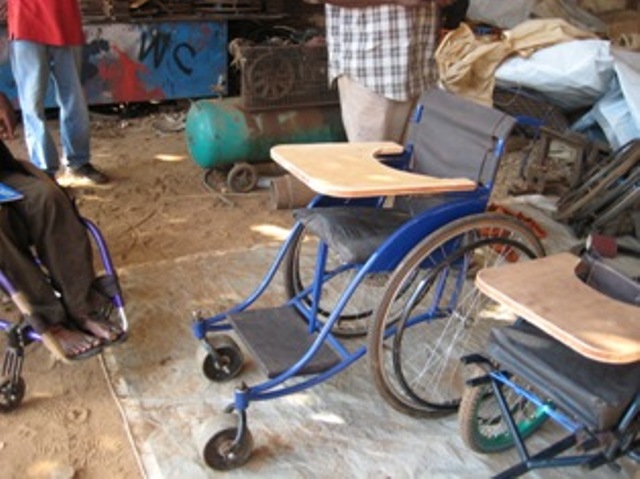
A well used old wheelchair from Mulago workshop

Can't get this to load upright but you get the picture. This chair can be made in two sizes. It is patterned after an old design called "the Huckstep."

The wheelchair design being made at this workshop has not changed for many years and needs upgrading. One of our objectives is to strengthen the local producers so we will have them make a limited number of chairs to help them grow. They will also supply the warehouse and security for the chairs when we get the shipment in the country.
Katalemwa Cheshire Home has an amazing rehab. center where they bring children for recovery after surgery and provide them with a place to stay and give them extensive therapy while they recover. They require that a parent or guardian stay with the child the whole time they are at the home. This allows the mother to learn to care for their child, the child will not be so frightened of procedures and the parent can guarantee the security for their child.
Mothers are given a chance to learn crafts and have a chance to sell their craft and earn some money to sustain them while at the center. Care is free or what ever the family can pay.

Katalemwa's wheelchairs are all of one design and they make the chair 3 different sizes.
They also have school for the children as they are often there for a long time. The day we were there the class was making jewelry and having a choir practice. The choir performs and helps the center with fundraising.
We met a mother and her baby at the center who lives in a remote village. The child's foot got infected and they tried folk medicine to help the baby but eventually the mother was directed to Mulago hospital but the foot was septic and they had to amputate the baby's foot. The good news is that Katalewma will follow this baby and support the mother with proper orthotics and therapy as the baby grows. This baby was beautiful and was doing well when we saw her.
We also met the poster child for the center. She is featured on their brochure. We could see why as she has a winning smile and a personality to match. She has cerebral palsy and is being cared for by the center. She certainly won our hearts.

We had to let the Dows go. They had other countries to visit and plan more wheelchair projects. They will continue to work on our project with us but from their home in California.
The next day we headed up to Gulu in search of GYDA.

The Gulu area has quite a history and has been ravaged by war many times and especially in the last 30 years. In 1986 local man, Josephy Kony brought together a cohort of rebel groups under the umbrella of the “Lord’s Resistance Army.” Kony claimed to be possessed by religious powers enabling him to be a medium. Having no known agenda or direction, the violent, unpredictable, and impulsive LRA movement began terrorizing the Acholi people.
The LRA would abduct children, maim people in grotesque ways, and raid schools, health centers in the day and at night. The descriptions of the crimes constitute some of the most vile ways of treating fellow humans. Ironically, the LRA claimed to be protecting the Acholi people as it terrorized them. Over 400,000 persons were internally displaced in Uganda in Gulu and Kitgum Districts. In 2000 the area suffered an outbreak of Eboli.
Fast forward to 2010 and you enter Gulu to see many people trying to put their lives back together. There is much rebuilding going on and the town only has a vestige of its past. There are many disabled people in the city and many in the outlying areas resulting from the wars and landmine accidents.

It's a three hour drive to Gulu. A beautiful drive where we pass right by the national reserve where there are several safari parks. You cross the Nile at a site where there are great rapids
and you often run into baboons sitting on the side of the road.
Gulu Youth Development Association (GYDA) is an organization that was started in 1992 by a group of youth with an interest in creating employment opportunities for the under-privileged youth in the district. The organization aimed at finding the means by which the youth could address their unemployment problems through a concerted effort and active participation in feasible economic, health, apprenticeship and training programs. It is a vocational school for underprivileged youth targeting street youth, orphans, disabled youth, school drop-outs, war effected youth and youth parents. They expanded their skills and in 1999 started making wheel chairs.

We had previously met Fred, the director of Gulu Persons with Disabilities Association, a wheelchair user himself. He is also a member of the National Wheelchair Committee. He met us at the center to introduce us and pave the way for a tour.
Upon entering GYDA's complex we were overwhelmed by the activity going on. Most of the youth were preparing for dinner. The center feeds its members a meal every day. All the kids were happy, joking with each other, and anticipating dinner. They all wore GYDA tee shirts and it was evident that everyone had been working that day. We visited a sewing room where kids were learning to sew the cushions for the wheelchairs.
There was a welding shop, a wood shop, an area for sealing and painting and a storage area with many wheelchair frames ready for assembly.
A graduate of the center, Thackery, was welding when we entered the workshop.
He had no legs and sat in a wheelchair. He was protected from the welding by goggles and a blanket. Kilama Robert, the administrator of GYDA, told us that Thackery was able to do welding because it didn’t take much strength and it was a good job for him. Farrell, looking at the young man’s muscular upper body told Robert that it didn’t look like he was lacking for strength as he had muscles bulging everywhere. Thackery grinned real big and we are sure we saw him blush.

The center has two Peace Corp. volunteers who will help their training center for two years. Drew had developed their website making it look very professional. They are a great asset as they give their service and expert advise.
This chair is for a student with a desk that can flip up while in the classroom.
Their wheelchair design has been modified and upgraded several times and looks much like the WORLDMADE wheelchair which is one of the chairs that the church has shipped in for projects. They receive most of their funding through USAID and are limited on their production of wheelchairs because of monies but estimate that their are 3,000 people needing wheelchairs at this time.

We left the center with Fred and went over to the Gulu Disabled Persons headquarters.
Fred was paralyzed at age 15 due to the treatment he received after falling out of a tree. He has dedicated his life to being an advocate for the disabled. He runs a peer training program for disabled people. It is a week course where the person receiving a wheelchair is brought to his center to live for a week and learn how to live with their disability. It is a do or die type training, something you might call boot camp. A person is removed from their caregivers and have to learn to survive. They are trained and taught by a peer, disabled person, to help them learn to be independent and care for themselves. They learn to live in a wheelchair and learn what they can do, not what they can’t do. It is a great program and will add a lot to our wheelchair project.

Fred works in Gulu with this association for the disabled but his home is just outside Kampala. It must be a labor of love as it certainly is real convient for him as he travels home by bus taking his wheelchair with him. This association works hard to meet the needs of the blind, the deaf, women with disabilities and landmind victims.

We have a lot of work to do. This is just the beginning. We are grateful for the Dows and their expert knowledge on developing the project. The project takes time and we project that distribution will not be until January of 2011. We can’t wait to get the project submitted. The changes in the program make it more complete. We plan on having local production make half the chairs and have the other half shipped in from World Made, a great wheelchair for this terrain. The only obstacle we can see is getting wheelchairs through the border. All things imported for the disabled come duty free and without any tax but for some reason things get held up at the border and in the past this hold up is lengthy. We pray for smooth sailing but will not be surprised if there is some difficulty; after all we are in Africa..
The church has given away thousands of wheelchairs in the past and they have come to realize that more is needed by the beneficiaries than just receiving a wheelchair. The new program tries to give the best designed wheelchair, one that fits well and the type that works the best in the recipient’s environment.

Monday, July 26, 2010

Crazy traffic in Kampala!

Driving in Kampala- A test of your metal
Still not as crazy as the Congo but at times very reminiscent.

We got caught downtown Kampala today - what an adventure!
The Bodas (motorcycles) look for any space to crawl through and often take space when there is none - they follow no traffic rules and move where ever they can find space.
About all you could do is sit and watch as traffic was going no where.
There was no where to go as everyone but the Bodas couldn't move but those bodas kept weaving around dragging their handlebars along your truck and stopping with their feet as brakes - Funny to watch actually.
Lots of shopping - lots of Bodas waiting for a customer.  They haul as many people as can fit for a small price.  We have seen a whole family on one and even 4 adults besides the driver.
Farrell got caught in idle and another car jumped right in when he had the nerve not to stay right on the bumper of the car ahead of him.
Some pedestrians will climb right over your car if you stay still too long.
Bodas were going in every direction with no semblance of obeying any traffic laws
Here comes one down the wrong way - doesn't look like it bothers him much.
Pedestrians, pedestrians, pedestrians everywhere!
Now normally Farrell would be asking,


"Where does he think he's going?"

" He can't do that!"

"I got the right-of-way buddy."

But today he just sat back and took in the scene - enjoying the ambiance of downtown Kampala - It was an experience that everyone ought to have once in their lifetime.

What a Ugandan experience!

Sunday, July 11, 2010

A special day in the bush . . .

Two weeks ago we received a request from Ecweru Musa Francis - Minister of State for Emergency Relief, Disaster Preparedness & Refugees of Uganda. He was asking for help in meeting the needs of some refuges who were recently returned to their homes up in northern Uganda in Bukedea and Kumi Districts. These people had fled the area and taken refuge in the cities when a rebel Kony of the LRA was wrecking havoc in the area killing many people. Now that Kony has been pushed into the DR Congo, Ecweru encouraged these people to return to their lands and start over.

They have been very industrious in their pursuit to re-establish their lands by planting orange trees, banana trees, various fruits and vegetables including cassava and corn. This year the rains have been very heavy and the neighboring wetlands in this area have increased consuming their fields and creating boggy gardens and orchards. The land is so wet that their home (thatched huts with dirt floors) are sitting in mud. They sleep on the wet ground and many of the elderly and children are contracting pneumonia.

Escweru had a list of goods he wanted to take to the people and asked if the church could help. We asked for his top, two items on his list which were tarps and blankets. He felt he could find other organizations to bring the other things. We were able to get cleared through our leaders in South Africa 1000 blankets and 1000 tarps.
We drove to Soroti on a Wednesday where we spent the night and got up the next morning to meet the minister and load up 400 of the blankets and tarps and headed northwest to two distribution sites. Minister Escweru rode in our truck with us, Ssimbwe, our site monitor driving and we were off with an entourage of a UN group, various other humanitarian organizations and a police escort of 6 armed police persons.

We had to stop at the District office and meet all the officials of the district and sign their register – then off to a meeting of the emergency relief group of the area filling a big room with about 30 people. Speeches were made and problems discussed all in the local tribal language. Thanks was given to the church for bringing relief supplies.
Finally we were off to the villages. As we got into the truck, Escweru stated that what he liked about our church was that we got the job done. He said all these other groups want to have a meeting first and assess the situation and eat sausages and drink soda. He felt they spent more money getting ready to help the people and they just needed to spend their money on the people instead. Seemed true enough as we were the only group who had brought anything to give while all the others were on a fact finding mission.

The land of Uganda on the surface looks like a paradise a virtual Garden of Eden.  It is beautiful, green and lush. We passed many people working in fields, fishing and selling on the roadside.
Look carefully you will see a man setting his fish traps
 We had to reroute several times as so many roads were washed out from the rains.  We finally pulled into a clearing where we were greeted by about 300 people standing under a very large, old tree. These people represented six different villages. The only people invited were women with small children and their husbands and the elderly men and women.

The people were very excited. They didn’t know why they were there only that the Minister had invited them to a meeting. The District Chairman spoke, the head of the emergency relief committee spoke and finally Ecweru got up and started to entertain.
I mean this man really knows how to work the crowd. He spoke in the native tongue and so we did not understand anything he said but he had them cheering, laughing, warbling and even singing. It was becoming a festive event. Finally he called the missionaries up and told the people we had come to bring them some help. We would give each mother a blanket and each father a tarp. They really got excited.

Farrell was asked to speak and Ecweru translated for him . The translation was much longer than Farrell’s speech and we knew he was still working the crowd. Farrell told them that we brought them a gift from people around the world who wanted to help them because that is what the Savior wanted us to do, to take care of each other.
We then distributed the blankets and tarps and Ecweru had brought some big pots. The women were so excited to have a pot and a blanket and the men received their tarp with great reverence never putting them down but hugging them to their chest.
As we left  a man told us "You have come to give us a healing touch, a healing hand."  The women started singing, waving and running alongside our truck saying thank you for the great gift.
As we pulled away Escweru said, “Today we have made their lives much better. Tonight they will put their children to sleep on the tarp away from the wet ground and cover them with a warm blanket. Tonight they will cook a meal for their family in their new pot, the only pot they own."  

Imagine living with no blanket, no rug or floor to sit on, no pot to cook in, not even a jerican to carry water. These people literally have only the clothes on their backs and a grass hut for shelter yet they are pushing forward trying to rebuild their lives, planting gardens and joining together to strengthen each other.

We were not finished yet so we headed to another village, which was very hard to find and we ended up driving on a foot path running through the grass.
This time we met the people in their village under a large mango tree.
They took us to their garden which was sad indeed. Mud was everywhere.
They had pulled up the cassava roots and laid them on the wet ground to dry. The roots were scrawny about 1/5th as large as they should have been and they crumbled in your hand when you broke them. They were also moldy. They were still trying to salvage some of the crop although it looked like a total loss to us.
They also showed us the sorghum which never developed enough to harvest. The corn had never set on any ears and so their harvest was a real failure and now they are looking at a lean season as they wait for the ground to dry enough to replant . . . but what will they plant as they have no seed to plant?
We returned to the mango tree for our little discussion. This time when they asked Farrell to speak he told them that he always got to speak so this time he would let his wife speak. Escweru really milked this explaining to them that Elder and Sister Barlow had great respect for each other and Elder Barlow wanted to have his wife speak this time and at that the women cheered and clapped – we did not see any men clapping.
I told them that we loved them. We knew that Heavenly father loved us and he loved them the same. He expects us to help each other and care for each other. The women loved this and they nodded and then clapped and cheered.

As we started to give out the blankets and tarps I noticed that all the women were barefoot. The men had on shoes but the women and children were barefoot -
They received the blankets and tarps with much excitement.
We did not have any more pots but we had brought a large bag of children’s clothes that people from the US Embassy had given us, the Dewitts and Radawn Kartchner.
The women were so excited and each mother got something plus each child got something to wear. There was a pair of bright, sparkly, pink slip-ons that were a big hit. One little girl wanted those shoes so bad. Escweru had her try them on but they were at least 4 sizes too small. She was so disappointed as he turned and gave them to another child. We did find her a cute pair of black velvet pants. Thanks Dewitts, Thanks Kartchners. We are sure you never had any idea that your children’s old clothes would become treasures here in Uganda.
One last box was left in the truck.  This box was actually things we had saved for Ssimbwa to take out to his village.  He told us that what we throw away as garbage is really not garbage and nothing goes to waste in the village.  We had saved plastic bags, empty cans, paper sacks, bleach bottles, etc.  We had set them in the truck so they would be ready for Ssimbwa and at the end of the day he just put the box out and the women came running to get something out of the box.  Some of them thought the bottles were full but were still happy to have the empty bottles and even the box became a treasure.
Smiles and hugs and big waves were given as we left this little village.
What an eye opener this adventure was. Going to this remote area of Africa felt like we were walking back into biblical times. Such a simple pastoral life they are living. Nothing goes to waste. There is no garbage in these areas. A vine, a twig, palm fronds and reeds are all used to weave baskets, make mats, and serve as utensils. A leaf of the banana tree can become a rain hat. Woven baskets are used as traps for fish. Baskets are so beautifully woven as to be water tight. Clay pots made from the dirt in the area are baked by the sun and used to fetch and store water. And although life is hard and the harvest has failed the people are not idle or complaining but busy trying to salvage what they can and prepare for the next season.
We were unable to finish the distribution in one day and the Minister had to return to Kampala for a meeting of Parliment so he planned on returning the following weeek.  We were unable to return so we sent Ssimbwa to finish up.
When they arrived at the first distribution site they were surprised to see so many people. Seems the word was out and hundreds of people had walked all night to get to the distribution site so they could get a blanket or a tarp.
As the distribution continued and the number of blankets and tarps dwindled the crowd became desperate not wanting to be left out.
Some had to settle for the ties and wrappings from the bundles of blankets.
An elderly lady had received a blanket and was very happy.  She told Ssimbwa it was the nicest blanket she had ever seen.  She said she was very old and would die soon but she was happy because she had a very nice blanket and she wanted to be buried in that nice blanket.
It was a honor to bring them some comfort. Don’t we belong to a wonderful church that gives so freely without banners or recognition but only the premise that the Lord loves all his children and we should give of what we have to help all his children.

“Verily I say unto you, Inasmuch as ye have done it unto one of the least of these my brethren, ye have done it unto me.” (Matt. 25:40)
So think about these people next time you are thinking about donating your monies to humanitarian services and know that the money you give truly is helping many people who have next to nothing and they need a hand up especially at this time and in this place when the “rains came down and the floods came up.”

“And charity suffereth long, and is kind, and envieth not, and is not puffed up, seeketh not her own, is not easily provoked, thinketh no evil, and rejoiceth not in iniquity but rejoiceth in the truth, beareth all things, believeth all things, hopeth all things, endureth all things.


“Wherefore, my beloved brethren, if ye have not charity, ye are nothing, for charity never faileth. Wherefore, cleave unto charity, which is the greatest of all, for all things must fail—


“But charity is the pure love of Christ, and it endureth cforever; and whoso is found possessed of it at the last day, it shall be well with him”. (Moroni 7:45-47)