Sunday, January 2, 2011

Luputa or bust

In April 2007 when we arrived in Kinshasa, DR Congo the Christensens had a wonderful water project ready to submit for the City of Luputa located in the middle of the DR Congo.  It was an ideal water project in that it was spring fed, delivered by gravity and no pumps or parts to wear out.  It was ambitious in that it delivered water 34 kilometers through 4 villages, ending in the city of Luputa.  The project was submitted the day they ended their mission but as usual nothing is that easy in Africa and the project required us to make 6 revisions before it was finally submitted to the First Presidency for approval.  Because the project was contracted over 3 years and was very expensive it took a lot of prayer and discussion to find the right project to move forward with.

We finally got approval for the project in Dec. 2007 and made our first trip to Luputa in January 2008.  Fast forward to Nov. 2010 and we are now in Uganda on another mission and were invited to return to Luputa for the closing ceremony and turnover of this amazing project. 

Elder and Sister Moody had extended their humanitarian mission to finish up this project and what a bang up job they did.

The trip to Luputa was much the same although the roads had been graded in some areas so not so big a potholes to fall in, our puddles that could swallow your car.
The scenery was still pristine country with the heavy laden bikes traveling to the city to take their harvested corn or cassava etc.
 Farrell found it still an adventure and shared some of the near misses of the trip with others.
Sister Moody was glad we made it safely and had dinner waiting, well kindof as everyone had already eaten and we were welcome to the leftover MREs.
 Daniel and Eustache (our traveling companions) loved the MREs and powdered milk.
The Moody's were hosting quite a crowd who they had to find housing for and feed and transport around.  They were on overload as they had extended their mission 3 months and had a lot of logistics to work out.. 

Traveling with us was Daniel (financial officer+ for the DRC) Eustache (CES), Elder and Sister Erickson (public relations for Africa South East Area), Bro Kubangila (public relations for the DRC).  Elder and Sister Renlund (Counselor in the area presidency),where presiding over the occasion and were accompanied by Pres. and Sister Packer (Mission President), Elder Kola (Area Seventy), and Bishop and Sis. _______.  Bro and Sis Christensen (hum. missionaries before us) were also there and had been in the DRC for a month doing a measles project and had come to celebrate with us.

We were to be housed at our favorite inn, the Catholic Monastery.  That was good, we had been there before and knew what we were getting into.  We were with Van and Marie Christensen and Daniel.
Nothing had changed at the Monastery as we still flushed and showered with a bucket.
On Monday we had a chance to go see the project as the celebration would not be till Tuesday.

A second project we had started for Luputa was a Cassava farm and processing plant.  The project had a slow start and was not completed till the Moodys came to the CongoFrom the cuttings of that project new farms were started and the church members now have a very productive cassava business.  You might call it the first welfare farm in Africa as it is feeding many members of the church in this area.
Nestor, project manager for the Cassava Project, Elder Erickson and Elder Barlow
Our next stop was the processing plant.  This is where the cassava roots are taken to be processed for sale.  Having the processing plant allows the growers to prepare the cassava for sale prior to sending to market.  This gives them a much better price and makes the production much more lucrative.

Cassava, although not a lot of food value is still the main staple of food for the Congolese.   They can pull off the leaves of the plant and eat as greens without harming the plant and allowing the edible roots to grow. 
First there is the peeling of the roots with very large knives.
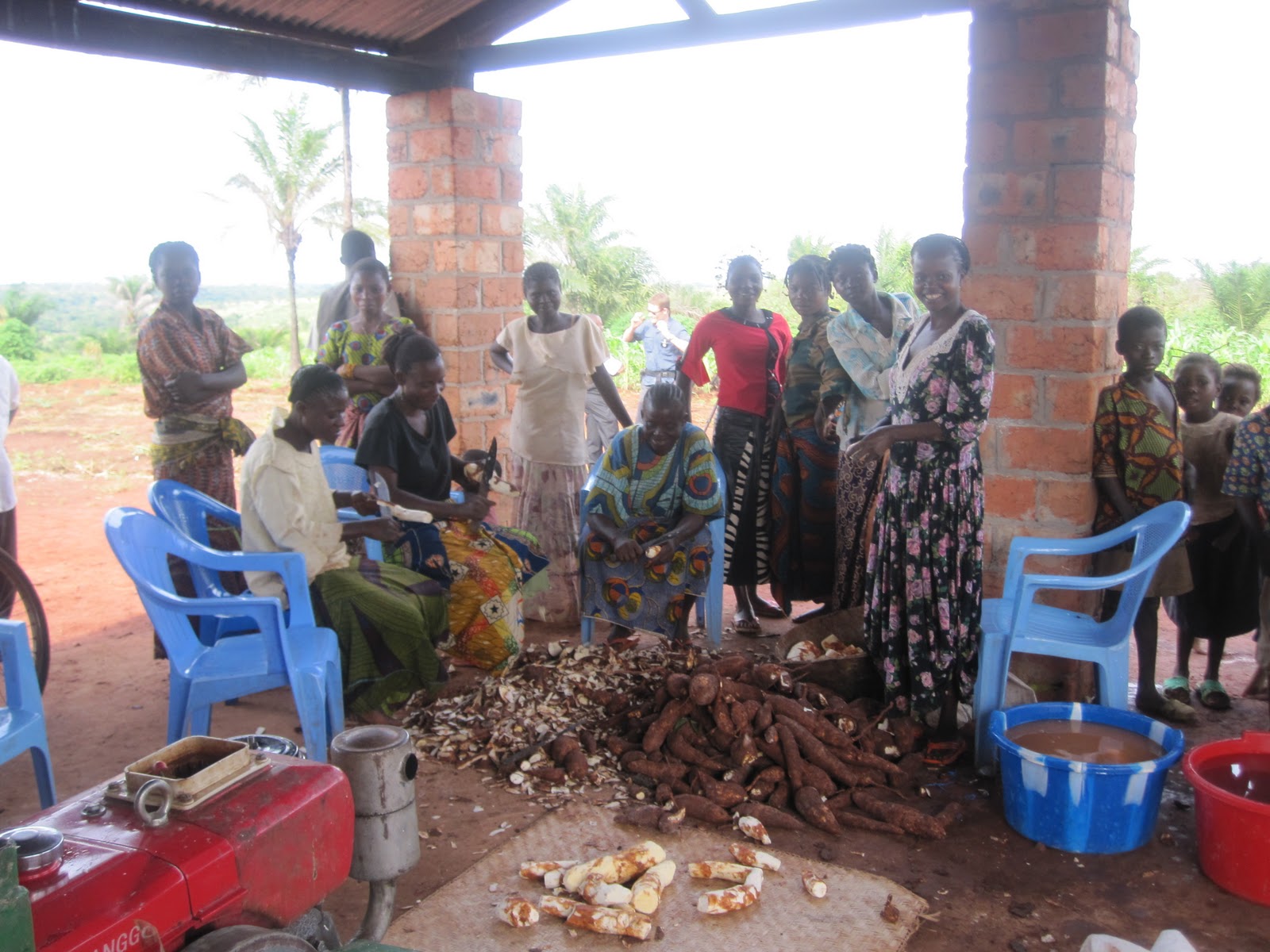
 Then wash the roots before they go into the chipper.
 Notice the back breaking bend that the Congolese do as they work on the roots.
 Then into the chipper where the roots are chipped into shavings almost.
Careful Marie, that is a very large knife.
 Once the chips are cut they will be soaked in the soaking bins to leach out arsenic that comes into the plant from the soil.
 After the soaking - into the press to get the water out so the cassava can be thoroughly dried.
Elder Renlund and Elder Kola tried their hand at the press, it takes some muscle
 .
Daniel and Eustache tried the macho approach.
The press may look archaic but without electricity this is a good tool.

Mamas of Luputa
Third stop for the day would be the water source.  This was rather nostalgic as we had taken this trek a few times in the past.
We found old friends at the source. The owner of the property was there (without his machete this time). He turned over the water rights to the communities so that the water could be diverted down to the villages - a very generous gift.

Another friend came to the site. He is the chief of the first village.  He said he wanted to come to the celebration but had no transportation.  We encouraged him to find a way as we would really like him to be there.
Christensens, chief, land owner, Sister Barlow, Elder Barlow, Elder Moody
January 2008 this picture was taken at the source.  This picture is part of humanitarian service display at the visitors center on Temple Square.  -  nostalgic.
November 2010 we are back and the water is headed down to Luputa.
As we headed back to Luputa we spied another old friend.  There at the Luputa Hotel ( I use that term loosely) was Dominique Sowa, the water contractor.  We love Dominique and the Luputa Water Project was his dream.  He had the dream of this project for 20 years before the church agreed to help him.  Many groups had looked at the project but no one would fund it.  This was a great reunion, one we thought we would never have.
By the time we got  back to the church's District Offices (our headquarters for the week) we had company.  Marie Josee came to greet us.  A dear friend with an orphanage she tries to hold together.  This day she was in tears as she had just lost a 6 yr. old child from starvation.  A brother and a sister were brought to Marie after they were found wandering in the bush.  They were extremely malnourished and Marie was able to save one but the oldest child died.  She was devastated. 
 The day was coming to an end and we all sat around the yard anticipating our MRE meal.  It was a good chance to reminisce a bit with Van Christensen (our hum. predecessor.)
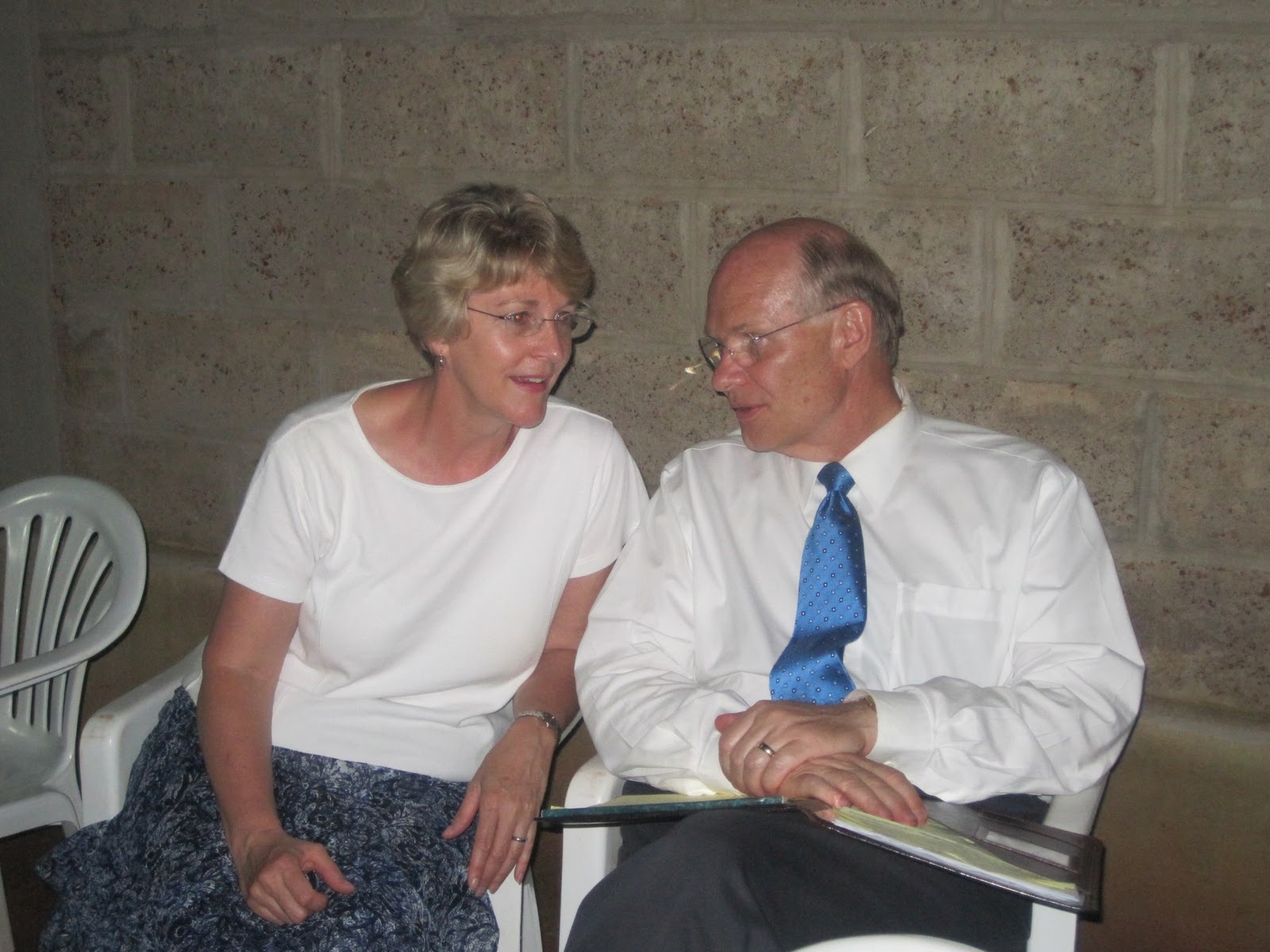
Elder and Sister Renlund were up for anything.  Their adventures never end serving in the Area Presidency.
The  three humanitarian country directors who worked on this project got to share all their frustrations and joys about running the Luputa project.
Elder Moody, Elder Barlow and Elder Christensen
Sister Barlow got to hang out with Elder Kola - he still can't quite figure out that camera.  Elder Kola is a choice humble man.  He has great wisdom and is a pioneer of the church in the Congo.
While we sat there visiting a truck came in and brought a cow, goats and chickens.  Dinner preparations were starting for the Celebration.  The animals were slaughtered and all parts of those animals were cooked right there in the District Office yard.
Incredible to watch (if you stayed away from the slaughtering) as the men and women prepared to cook for 500 people without electricity or modern conveniences.

Tomorrow was going to be a big day.  We had no idea what to expect.

Sunday, December 26, 2010

Merry Christmas from Uganda

Merry Christmas  to all our old friends, new friends and all our wonderful family.
As we sit down to our Christmas dinner it is 80 degrees outside and 100% humidity, in fact it has rained all morning. 
 We have had a month of Christmas giving and serving in the name of LDS Humanitarian Services - it has been a wonderful month that has wrenched our hearts and warmed our hearts all at the same time..

 DECEMBER 9th - Kiryandongo IDP Camp (Internally Displaced Persons)
Note kite - made from plastic bags.
500 blankets and 400 mosquito nets distributed to help with the problems of malaria among the children. 
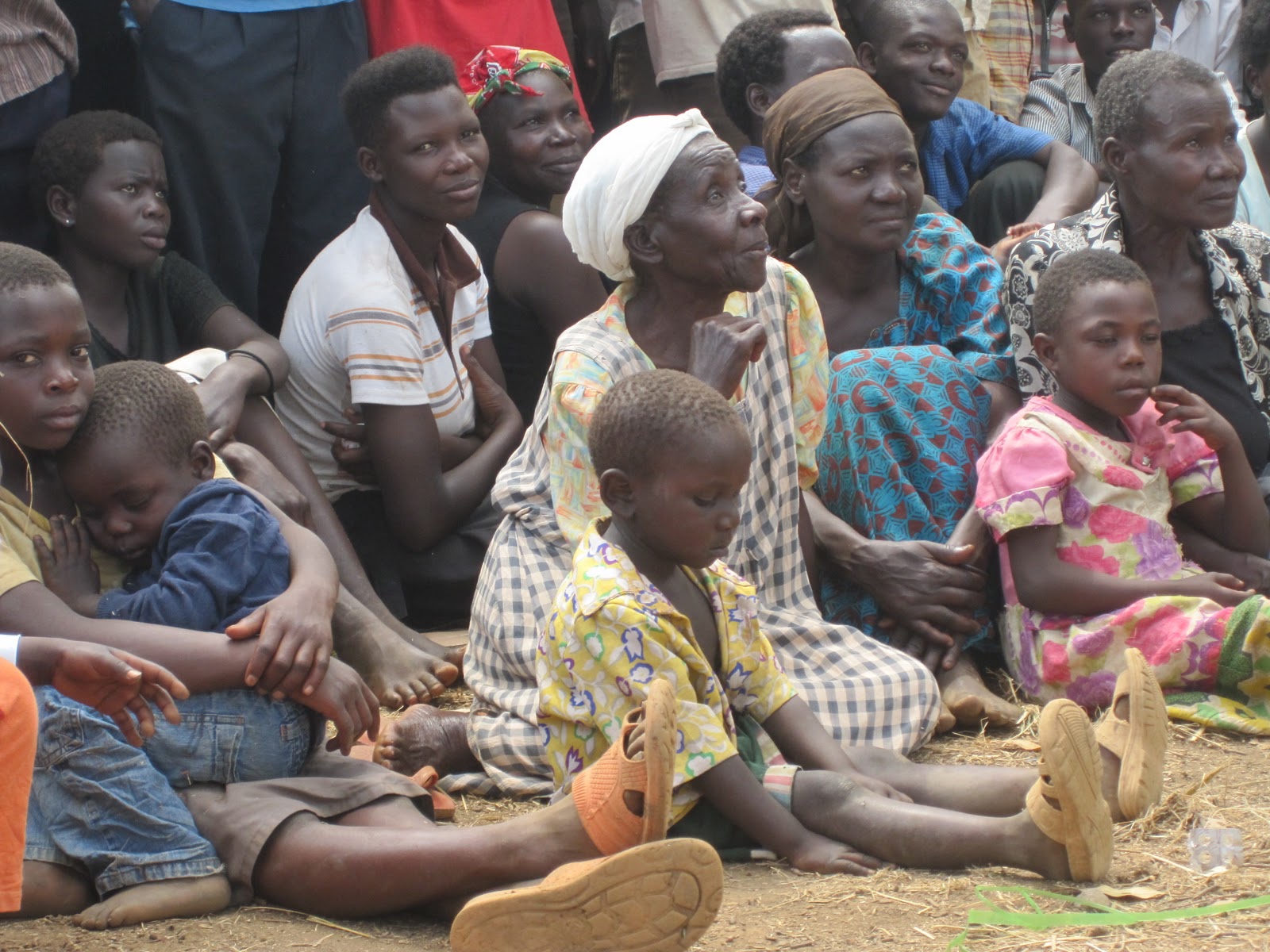
These are the people who were evacuated from the Bududa mud slides on Mt. Elgon, a disaster that happened just a couple of weeks before we arrived in Uganda.  They were given immediate relief then and are now in IDP camps and are now being asked to move out to 2.5 acre plots to start a new life in a new area.  They are without working wells, latrines or houses on their new land and so many were staying in the IDP camp until they can get shelter and sanitation problems resolved.
The women of the camp told Minister Esweru (Minister of Emergency Relief and Refugees) that they appreciated the blankets and mosquito nets but they had more needs, very basic needs,  They needed salt and soap desperately.  The minister sent for salt from the closest town and gave out the salt while we were finishing up the blankets and mosquito nets distribution.  When the salt arrived the people became very desperate for the salt and pushed and grabbed trying to secure a share.  In the process a couple of bags of salt were torn and were spilled into the dirt.  As people dispersed , those without came and gathered up the spilled salt along with the dirt trying to salvage some of the salt. -  heart wrenching..
One man asked if we would be returning.  He said that there were 5 groups in the camp and we only distributed to 3 of them.  Apparently his group did not get any blankets or mosquito nets.
Ssimbwa was with us at the distribution and it was hard for him to see his people suffering and in such need. On the way home he started to think about ways we could help with more salt and other relief which the people seemed to need.  When he got home he met with our bishop and discussed how the members of our Makindye ward could help the people of Kiryandongo.  All week the ward and many nonmembers have been collecting bags of salt, clothing and anything else they wanted to donate to take back to the IDP camp.  Next week a couple of trucks will return to the camp with the donated items.  We are witnessing people who have very little putting the needs of others ahead of their own and working together to give relief to people who are desperate for the basic needs of sustaining life - heart warming

Dec.12th - Rubaga People with Disabilities
After 4 months of struggling to get an industrial knitting machine for the Rubaga People with Disabilities Association we were finally successful.  The project for this association was in jeopardy of failing due to the delay in getting this knitting machine.  The  group had hinged all their expenses for their training program on the production of this knitting machine.  We met the vendor at the training center and paid for the machine.  The one member of the association that knows how to use the machine was there learning the specifics of maintenance and was very excited to get started on sweater production and training others how to knit. 
As we were getting ready to leave Lillian our contact told us that the trainer was struggling with his wheelchair which is very old.  It had two flat tires and needed some repairs to be workable.  He was having a difficult time getting to the training center as he was having to move on his hands and knees, a difficult and dangerous way to travel in Kampala.  They wanted to know if we could get him a new wheelchair with our wheelchair program.  We are unable to help him as the wheelchairs are being distributed by the partner organizations and we are unable to just give out wheelchairs.  We realized that the success of the knitting training hinged on the being able to be to the center each day working and training - heart wrenching.

After we returned to our car we both looked at each other and said Merry Christmas and got out the 120,000 shillings needed to repair a wheelchair and returned to the training center and gave him the needed money.  He was touched, overwhelmed and left right then to arrange to have his chair repaired -heart warming.

Dec. 22nd Amuria Emergency Relief for flooded farms.

We spent two days doing distribution to 3 areas in Amuria District that has been hit so hard with flooding causing their crops to fail and increasing the chances of disease.
Distribution of 400 mosquito nets to mothers of Alasi, Ojamai and Osepai Villages .  This area has had a high incidence of malaria among the children and several children have died from this awful disease.  It is estimated that in Uganda over 100,000 children die of malaria each year - heart wrenching.  The best protection from malaria is to sleep under a mosquito net - .  The mothers were not told what relief they were receiving and when we told them we had brought them mosquito nets there was quite a cheer that went up.  .  They said we were the first white people to ever come to their villages. 
They all wanted to shake your hand and speak kind words to us in their native language.  We would say Merry Christmas and they would say, "God bless you."

Distributed 400 hoes at Abia Parrish and Agwaia Parrish. 
These people are victims of heavy rains are are struggling with flooded gardens and fields causing crops to fail.  Their hands were calloused, rough and cracked from hard work.  The feet were bare and covered with dirt.  The clothes were tattered and it was obvious that these people were struggling to survive with the barest of essentials  - heart wrenching.
At the request of Minister Escweru we had brought hoes for each family to help them prepare the ground for a new planting.   The people had to walk quite a distance and all came excited to receive some relief.  They were not told what they were getting but were very excited when Farrell told them that we had brought hoes to assist them in planting their gardens.  The hoes were the metal blades without the handle as they will hew their own handle but the blades were good, heavy hoes weighing 3 lbs each. 


Everyone we met were gracious and happy for the efforts of the church in assisting them.   The need is great - the problems are many - the people are all God's children and deserve the basic essentials needed to sustain life.  It is heart warming as you see people greet each other warmly, laugh together and strive to help and support each other.

Sister Barlow gets to hang out with the women.

Elder Barlow gets to hang out with the spiders.  The whole time he was passing out the hoes he was standing under a huge spider web just a few inches above his head.

December 23rd - Amahoro Orphans Home

Several months ago Caleb and Ritta came into our office just wanting to talk.  He said he had 3 homes in which he was caring for street kids and abandoned children.  He had just taken in a 2 year old who was paralysed and abandoned on his doorstep of his children's orphanage.  He is newly married and he and his wife have the responsibility for all three homes.  Caleb was a street child who was able to find a way to get an education by working for a school for school fees and he got through school and went to the university with the help of some kind people.  He now has a good job with the water company in Kampala.  He feels he has to care for street children as he remembers how hard it was to live on the street.  He said that the hardest time for him as a street child was 5:00 pm when everyone went home to family and he had no where to go.  He asked us if we had any friends or members of the church who would just visit his kids and read to them and let them know that someone cared about them.   We sent a good Ugandan friend, Olivia, and she has been going weekly to the orphanage ever since serving , loving the children, teaching and being an extra mom to 40 children.

We wanted a missionary service project  for Christmas so we took the Thaynes, Sis. Beachley and her daughter, sister in law and a friend, Daniell Gardner who is visiting.  Olivia and her daughter Maria went with us also.  We took rice and beans, apples and oranges and the Danielle brought 15 homemade children's blankets to give out.

Olivia and her daughter brought Barbie type dolls along with yogurt and cookies for all the children.
We were smitten before we even got to the front door as the children came running out to greet us giving us hugs and tugging us by the hand into the yard. 

The children range in age from 2 to 16.  There are 7 staff members.  They grow a lot of their own food and said they would be self sustaining in another year for enough food to feed the children.  The bedrooms were clean and neat and the children were clean and dressed in adequate clothing.  Olivia had sewn uniforms for a school that never picked up the finished uniforms so she gave them to the children and several of them had on the blue uniforms when they greeted us. 

Elder Barlow made some new friends who followed him wherever he went.
They asked us to plant a tree so they would remember our visit and we planted 2 mango trees and gave them names.  One we named Michael Adam after our son and Elder Thayne named one Dotty after Sis. Thayne. 
These children come in many different packages.  Two children, a brother and sister age 1yr. and 3 yrs,. were abandoned on the streets of Kampala.  A  young girl 14 yrs was sold by her father to a man.  She ran away and the police brought her to the orphanage.  She is pregnant and very scared.  A baby, estimated to be 2 yrs. old was left on the door step of the orphanage.  He is paralysed and cannot sit up on his own.  Another child came to the orphanage very ill with Sickle Cell Anemia and has had complications causing paralysis.  Each child has a heart wrenching story.
Elder and Sister Thayne made many new friends.
The children love oranges but most of them had never tasted an apple before.
What's a party without balloons.


One young woman, Daniell) had an experience of a life time giving service and enjoying every minute of it.
 As we left the orphanage Farrell gave Caleb some money, a donation, to help where he needed it.  He was very appreciative.  He is trying to find the money for a special chair for his handicapped kids.  The cost is more than we gave but we hope the money will help him find the right wheelchair that may be used for both children.  I wish we had access to one of those great big tire jogging strollers they have in the US or a custom chair suited for their needs. 

 Amohoro Home, Amohoro meaning 'Peace', is a wonderful place doing good things for a lot of children.  These children have it better than many other children we see and we applaud Caleb and Ritta in their efforts of caring for these children.- heart warming.

So this holiday season we wish you a very Merry Christmas and want you to know that we love you, we are thinking about you and we have made some personal service efforts this season in your behalf.  Instead of presents, neighborhood treats, parties or Christmas cards we have  bought salt and clothes for the people of Kiryandongo, repaired a wheelchair for a man who desperately needed his chair and tried to help some orphans in an effort to say

Merry Christmas
 to you and
Peace on Earth and Good Will to all Men