Saturday, August 21, 2010

Eddie Mutebi - Fast Eddie


One of the great things about going on a mission is the people you meet along the way. It is such a blessing to get to know people from a totally different culture and realizing that we are all God’s children and that we are just one of the grains of sand on the sea shore.

One of the delights of our mission here in Uganda has been to meet Eddie Mutebi. Here is a young man, 30 years old who seems to own the world. He is an active member of the church. He is not married but is engaged to Winnie but with no set wedding date in fact the marriage date changes every time we ask. He has so much going on he can’t find time to get married.

The Glenns (our predecessors) hired Eddie as a site monitor and used him to solve problems on several projects. He is mild mannered, quiet and full of energy. He can get more done in a day than anyone we know. That must be why Sis. Glenn dubbed him “Fast Eddie”.

When we got to Uganda Eddie was the contractor on the Mukono Springs water project. That project went very smoothly and we soon learned that Eddie is an amazing young man with many talents. He has put together a company called Union of Community Development Volunteers - Uganda (UCDVU) a community based organization that has 30 volunteers working to do good in the community. They secure homes for orphans, teach HIV/Aids prevention, train communities in health and hygiene and many other services. In the organization he has developed a natural springs development company that takes natural springs and turns them into a viable clean water source.
Eddie’s company is going international and will be developing springs in Rwanda for a big water project for the church, the first water project the church has done in Rwanda. But today Eddie is managing our water project in Masaka.

When we went to Masaka last week for a look-see at the project Eddie took us around to the schools and gave us the grand tour. While we were on the road we passed a very unassuming little house made of mud that we wanted to take a picture of.
Eddie said we would stop on the way back and see it. Seems the little house was his birthplace, the home his grandfather had built for his grandmother when they were first married.

Eddie was born in Bubondo Village in Masaka District. When he was 1 ½ years old his mother died during childbirth leaving 9 children for her husband to raise. Eddie’s grandmother came and took him home to relieve the father of some of the burden of parenting. Eddie’s father remarried having 6 more children but Eddie was raised by his grandmother and grandfather. His grandfather had served in WWII in northern Africa and left quite a legacy for Eddie. Eddie was raised with his uncles and aunts and they treated him as their little brother.
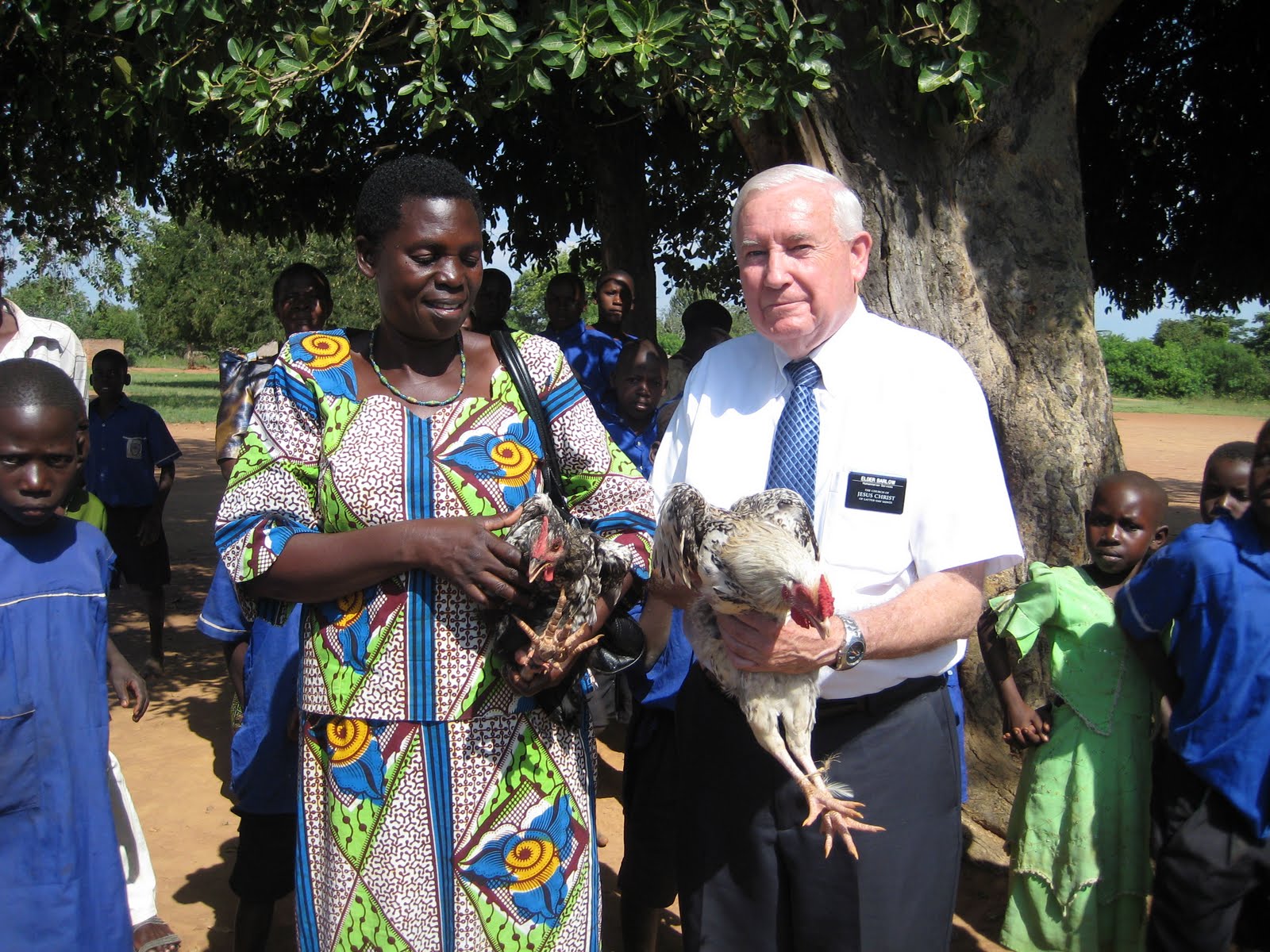
Grandmother was a great teacher who taught Eddie to work hard. He raised chickens to pay his school fees and put himself through primary and secondary school.

Eddie is the only member of the church in his family. He left Masaka with a man who was going to take him to So. Africa. When they got to Kampala the man dropped him off and left him. Eddie was in a strange city where he didn’t know anyone and he had no money. He wandered the streets until a stranger invited him to stay with his family while he found work. While on the street he met the missionaries and before long he joined the church where he received the fellowship and security he so desperately needed. He has served as a ward clerk for the past seven years and seldom misses a Sunday even though he often spends the week out of town on a job he always comes home for Sunday as he says the bishop is counting on him to be at church to fulfill his calling.

Eddie is a very successful businessman.  Many of his employees are much older than he and he is a good boss, taking very good care of his employees by paying them a good income, providing food and housing for them on the job and providing medical care for them.  He said that his family can’t believe that he has a company that is coming back to their village to bring them clean water.

We will be working with Eddie’s Primary school on the Masaka project building a latrine and water catchment system and when we went to visit the school the head mistress said, ‘ Our little Eddie has come back to bless us. This is a reward we get for educating such fine young men.’
Gertrude, Head Mistress of St. Bruno Primary School
Eddie’s father is gone now and his grandmother recently passed away. It was a difficult time for Eddie to lose his grandmother as he always knew she was there for him and gave him great council and praise making him feel he could do anything. He attributes his success and work ethic to his grandmother’s teachings.
Eddie gave elder Barlow a tour of the homestead.
Eddie’s uncle still lives next door to the homestead and one of his cousins sleep in the old house. We spent some time with his family, most of who do not speak much English.
Eddie took a bag of suckers we had brought and treated all his cousins.
Eddie took a bag of suckers we had brought and treated all his cousins. You could feel the love of this family as they laughed and talked in a language we could not understand.
Eddie’s cousin brought out this great clay pot.  Eddie said his grandfather had made the pot over 50 years ago. It is used to store water and they still use it.
It is Eddie’s treasure and the family is keeping it safe for him till he has his own home. But next to the ancient clay pot was the proverbial jeri can rigged to catch the rain water,
using a banana tree stalk as a funnel for the water running off of the tin roof of Eddie Mutebi’s birthplace, the home built by his grandfather 50 odd years ago.

Some day you may be able to see a plaque on that house stating, “The Birth Place of Eddie Mutebi, Prime Minister of Uganda.”

Sunday, August 15, 2010

Kamuli

Time to assess Kamuli-Iganga-Kagoma Water Project. The first week in Uganda we traveled out to Iganga for a turnover of some boreholes to the community but this time we were going to Kamuli.

Paved road from Jinja to Kamuli but once off the road you are on dirt roads.
Kamuli is about 2.5 hours from Kampala with rolling hills and lots of farming, There is the town but most of Kamuli is rural with a population of about 720,000 people. Farming consists of millet, potatoes, beans, maize and sunflower. Cash crops like cotton, coffee and Sugar cane are there but most are run as foreign corporations and pay poor wages to the workers. There is a lot of fruits and vegetables like tomatoes, potatoes, onions, bananas (many kinds), papaya and mangos. Each family has a garden and many have a cow, chickens and goats.
Typically housing for many of the people in Kamuli District
In spite of the ability to grow their own food there is very little cash in a family and money for school fees and clothing is very limited. Most people range in the poverty level. As everywhere in Uganda there are a great number of orphans. In this area orphans comprise 7% of the population.

We were hosted by our site monitor Katuntu Hannington.
A handsome Ugandan who says he is a man of few words but he always seems to have plenty to say. He was born in Kamuli but lives in Kampala for work purposes and to have a place to educate his 4 nieces and nephews who he has supported since his sister and brother-in-law died of Aids.


He is part of an NGO called GILEAD. They are a community development organization trying to help the people of Kamuli pull themselves out of poverty. This group built the latrines that the church funded for this project. Hannington acted as our site monitor coordinating this project of boreholes and school latrines with rainwater catchment systems for each school.
Hannington brought along Betty who had been teaching the recipients of this project hygiene and sanitation training. She is an amazing lady who is retired from a government job and now works with Gilead as the hygiene and sanitation trainer.

Visiting the schools to verify the work done was our priority this trip. We had 2 days of seeing schools and one turnover ceremony representing all the schools in the project.

Word didn’t make it to all the schools that there was just one ceremony as each school we visited decided to have their own ceremony with speeches, food, singing, dancing and gifts.
We would pull into a school yard to find all the students lined up cheering and singing on our arrival.
This was in spite of school being in recess and no one was suppose to be at the schools when we visited.
We hurried the process as fast as we could and still be polite but it was obvious that the leaders and teachers of the schools were elated to get a latrine and to get a rainwater catchment systems meant many hours saved from having to send children to haul water.
Notice the tire rim. .  that is the school bell
Many pictures and sayings painted on the school walls.  ELDER Barlow loved this one.

Hand washing station outside of each latrine.Each latrine had 5 to 8 stances with a hand washing station outside the latrine (usually the latrine was the best looking building on the school campus.).

Farrell dubbed this the teachers lounge.  It had a bench and a nice breeze blowing through.
Each school also had gutter installed draining in to a 10,000 liter water tank.
Note the decoration for our visit
Rain water is plentiful 9 months out of the year so this was a great gift. Many of the schools were being threatened with closure if they didn’t get an adequate latrine so much of the singing was about ‘getting a latrine so we can continue to go to school.’ 
Oh and we had to cut the ribbon to officially open the latrine for use.

We were given gifts of appreciation including giant mushrooms, papya, sugar cane, oranges and the best gift, two live chickens.
Farrell tried to get them to keep the chickens but Hannington told us it would be impolite to refuse such a gift as they were giving all that they had.


We bumped along the dirt roads and those chickens put up quite a fuss then Farrell hit a big hole that made us fly through the air and suddenly the chickens went quiet. We feared the worst.


We traveled to the far end of Kamuli which ends at lake Kyoga.  What a site we saw.

Laying on the ground being dried was a blanket of little silver fish. These fish are called Mukene fish. Fish is a cheap source of proteins for both humans and domestic animals. The Mukene is important as food to the Nile perch, the most important export fish in the country. The Mukene fish is fished at night by light attraction. Kerosene lamps are floated on water attracting fishes to light. Mukene is then fished out using scoop-nets and nets pulled from the shores (beach seines) and from canoes (lampara nets). These fish are approximately 48 mm, They are dried and reconstituted as needed for food.


On our way back to Kamuli town we visited two old borehole sites from a project 4 years ago. We found them working well. The people were originally pulling water from a pond and a lake both of which were great health risks. Guinea worms are very prevalent here along with many other illnesses that are spread by these contaminated waters. The people sang and clapped and told us how much they relied on these boreholes. They asked if we could get them mosquito nets as they were suffering with much malaria and needed nets to protect their children

We had brought with us some dresses sent to us from some Relief Society sisters in St. George, Utah. Betty handed them out to women she knew who were widows or living in extreme poverty. They were elated and everyone cheered when they saw these women get a new dress.
As housing in Kamuli is limited at least for "muzungus" like us we had opted to stay in Jinja at the Nile Resort, a lovely place with good food. When we left Kamuli to head to Jinja it was already 7:30 PM and we were being disobedient to mission rules as we are not suppose to drive after dark. The sun had set and by the time we got on the road it was very dark. The road is narrow with many pedestrians and bicycles on the side. Passing another car is difficult even when it is light as the road drops of as you leave the pavement. So, it was dark and there were no street lights and we were dependent on our headlights to show the way. We were navigating pretty good with a a few scary passes with buses and large trucks but we were making it when we had a blow out. Knowing of the security problem we were in Farrell kept driving on the flat tire until we saw one lonely streetlight at a roadside market. He pulled off and immediately we were surrounded by many helping hands that thought they knew how to change a tire.
Six men clamoring for the chance and at least that many little boys wanting to watch what was going on. At one point we had four men tugging on the tire with 4 little boys laying under the truck trying to watch (in the dark). Farrell made the boys get out from under the truck and promised to pay only one man for the work. It wasn’t long before we were back on the road riding on our spare tire.


After our trip we were informed by church security that one of the ploys to get at Americans was to throw obstacles in the road causing people to stop and then evil people would come out of the bushes and do you harm.


Thank you Heavenly Father for watching over us not so smart missionaries and keeping us safe.
View of the Nile from our hotel room.  It really was worth traveling back to Jinja to spend the night where we could eat safe food and have a shower.  The next morning we found monkeys playing on our cottage and swinging through the trees.
Oh, about those chickens.  When we got back to Kamuli town and opened the truck the chickens were just fine. but the back of our truck was quite a mess.  We gave the chickens, the mushrooms and the fruit to Betty to take home.  She was pleased and more than happy to add two chickens to her brood.

Sunday, August 1, 2010

Wheelchairs - big, big, big project

On July 12th we welcomed John and Marcia Dow to Uganda.
They have come in answer to our request for a wheelchair specialist to help us plan a wheelchair project. The church’s wheelchair program has changed focus and instead of giving out wheelchairs to those in need it involves finding a partner and distributing wheelchairs through the partner. The partner has to be someone with the ability to produce wheelchairs, assess recipients, custom fit the chairs, and then train recipients in using the wheelchair helping them to become more independent.


We spent a couple of days visiting wheelchair production sites in Kampala. Uganda has a National Wheelchair Committee that has outlined the same goals for recipients that we have and it looks like we will be able to partner with them and meet all of our requirements.
We met with Rose, Chairmen of the National Wheel Chair Committee, and asked her to help us visit the wheelchair production sites in Uganda. We had a sit down meeting with some of the members of the committee and made a plan.
Patrick gave us a tour of Mulago Hospitals wheel chair production. Wentz gave us a tour of Katalemwa Cheshire Homes Rehab. Center and we made a trip north to Gulu to evaluate Gulu Youth Development Association's workshop.

Mulago's workshop is housed in the old hospital that was built in 1935. The new Mulago Hospital is the largest government hospital in Uganda it is the hospital that receives referrals from all over Uganda. It has a lot of good things going on but as all hospitals in Africa it has great needs.
A well used old wheelchair from Mulago workshop

Can't get this to load upright but you get the picture. This chair can be made in two sizes. It is patterned after an old design called "the Huckstep."

The wheelchair design being made at this workshop has not changed for many years and needs upgrading. One of our objectives is to strengthen the local producers so we will have them make a limited number of chairs to help them grow. They will also supply the warehouse and security for the chairs when we get the shipment in the country.
Katalemwa Cheshire Home has an amazing rehab. center where they bring children for recovery after surgery and provide them with a place to stay and give them extensive therapy while they recover. They require that a parent or guardian stay with the child the whole time they are at the home. This allows the mother to learn to care for their child, the child will not be so frightened of procedures and the parent can guarantee the security for their child.
Mothers are given a chance to learn crafts and have a chance to sell their craft and earn some money to sustain them while at the center. Care is free or what ever the family can pay.

Katalemwa's wheelchairs are all of one design and they make the chair 3 different sizes.
They also have school for the children as they are often there for a long time. The day we were there the class was making jewelry and having a choir practice. The choir performs and helps the center with fundraising.
We met a mother and her baby at the center who lives in a remote village. The child's foot got infected and they tried folk medicine to help the baby but eventually the mother was directed to Mulago hospital but the foot was septic and they had to amputate the baby's foot. The good news is that Katalewma will follow this baby and support the mother with proper orthotics and therapy as the baby grows. This baby was beautiful and was doing well when we saw her.
We also met the poster child for the center. She is featured on their brochure. We could see why as she has a winning smile and a personality to match. She has cerebral palsy and is being cared for by the center. She certainly won our hearts.

We had to let the Dows go. They had other countries to visit and plan more wheelchair projects. They will continue to work on our project with us but from their home in California.
The next day we headed up to Gulu in search of GYDA.

The Gulu area has quite a history and has been ravaged by war many times and especially in the last 30 years. In 1986 local man, Josephy Kony brought together a cohort of rebel groups under the umbrella of the “Lord’s Resistance Army.” Kony claimed to be possessed by religious powers enabling him to be a medium. Having no known agenda or direction, the violent, unpredictable, and impulsive LRA movement began terrorizing the Acholi people.
The LRA would abduct children, maim people in grotesque ways, and raid schools, health centers in the day and at night. The descriptions of the crimes constitute some of the most vile ways of treating fellow humans. Ironically, the LRA claimed to be protecting the Acholi people as it terrorized them. Over 400,000 persons were internally displaced in Uganda in Gulu and Kitgum Districts. In 2000 the area suffered an outbreak of Eboli.
Fast forward to 2010 and you enter Gulu to see many people trying to put their lives back together. There is much rebuilding going on and the town only has a vestige of its past. There are many disabled people in the city and many in the outlying areas resulting from the wars and landmine accidents.

It's a three hour drive to Gulu. A beautiful drive where we pass right by the national reserve where there are several safari parks. You cross the Nile at a site where there are great rapids
and you often run into baboons sitting on the side of the road.
Gulu Youth Development Association (GYDA) is an organization that was started in 1992 by a group of youth with an interest in creating employment opportunities for the under-privileged youth in the district. The organization aimed at finding the means by which the youth could address their unemployment problems through a concerted effort and active participation in feasible economic, health, apprenticeship and training programs. It is a vocational school for underprivileged youth targeting street youth, orphans, disabled youth, school drop-outs, war effected youth and youth parents. They expanded their skills and in 1999 started making wheel chairs.

We had previously met Fred, the director of Gulu Persons with Disabilities Association, a wheelchair user himself. He is also a member of the National Wheelchair Committee. He met us at the center to introduce us and pave the way for a tour.
Upon entering GYDA's complex we were overwhelmed by the activity going on. Most of the youth were preparing for dinner. The center feeds its members a meal every day. All the kids were happy, joking with each other, and anticipating dinner. They all wore GYDA tee shirts and it was evident that everyone had been working that day. We visited a sewing room where kids were learning to sew the cushions for the wheelchairs.
There was a welding shop, a wood shop, an area for sealing and painting and a storage area with many wheelchair frames ready for assembly.
A graduate of the center, Thackery, was welding when we entered the workshop.
He had no legs and sat in a wheelchair. He was protected from the welding by goggles and a blanket. Kilama Robert, the administrator of GYDA, told us that Thackery was able to do welding because it didn’t take much strength and it was a good job for him. Farrell, looking at the young man’s muscular upper body told Robert that it didn’t look like he was lacking for strength as he had muscles bulging everywhere. Thackery grinned real big and we are sure we saw him blush.

The center has two Peace Corp. volunteers who will help their training center for two years. Drew had developed their website making it look very professional. They are a great asset as they give their service and expert advise.
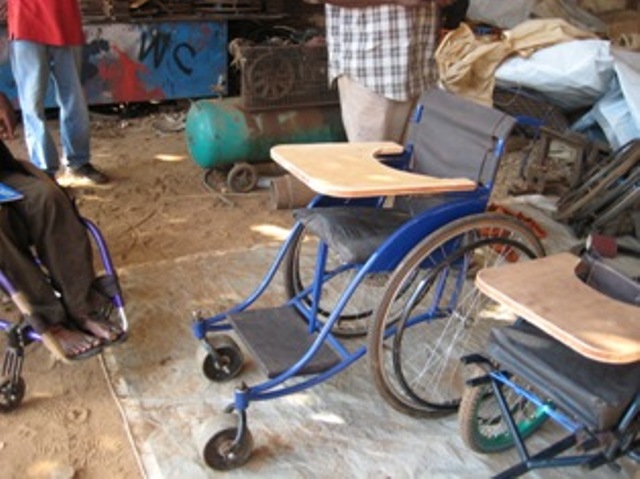
This chair is for a student with a desk that can flip up while in the classroom.
Their wheelchair design has been modified and upgraded several times and looks much like the WORLDMADE wheelchair which is one of the chairs that the church has shipped in for projects. They receive most of their funding through USAID and are limited on their production of wheelchairs because of monies but estimate that their are 3,000 people needing wheelchairs at this time.

We left the center with Fred and went over to the Gulu Disabled Persons headquarters.
Fred was paralyzed at age 15 due to the treatment he received after falling out of a tree. He has dedicated his life to being an advocate for the disabled. He runs a peer training program for disabled people. It is a week course where the person receiving a wheelchair is brought to his center to live for a week and learn how to live with their disability. It is a do or die type training, something you might call boot camp. A person is removed from their caregivers and have to learn to survive. They are trained and taught by a peer, disabled person, to help them learn to be independent and care for themselves. They learn to live in a wheelchair and learn what they can do, not what they can’t do. It is a great program and will add a lot to our wheelchair project.

Fred works in Gulu with this association for the disabled but his home is just outside Kampala. It must be a labor of love as it certainly is real convient for him as he travels home by bus taking his wheelchair with him. This association works hard to meet the needs of the blind, the deaf, women with disabilities and landmind victims.

We have a lot of work to do. This is just the beginning. We are grateful for the Dows and their expert knowledge on developing the project. The project takes time and we project that distribution will not be until January of 2011. We can’t wait to get the project submitted. The changes in the program make it more complete. We plan on having local production make half the chairs and have the other half shipped in from World Made, a great wheelchair for this terrain. The only obstacle we can see is getting wheelchairs through the border. All things imported for the disabled come duty free and without any tax but for some reason things get held up at the border and in the past this hold up is lengthy. We pray for smooth sailing but will not be surprised if there is some difficulty; after all we are in Africa..
The church has given away thousands of wheelchairs in the past and they have come to realize that more is needed by the beneficiaries than just receiving a wheelchair. The new program tries to give the best designed wheelchair, one that fits well and the type that works the best in the recipient’s environment.