Sunday, August 14, 2011

Strengthening a vision program.

"I can't believe it.  I didn't think you were serious.  I never thought you would come back.  I am so happy." Justine, head nurse - St. Joseph's Eye Clinic

One year ago we started planning what we could do for a vision project for Uganda.  Although we didn't have authorization for a vision project we began our planning and asked to have Dr. Hunsaker make a stop in Uganda on his way to do a vision project in the DR Congo.  Permission was granted.  He came and visited Mulago Hospital and St. Francis eye clinic to see if they would be viable partners for a Major Vision Project.
Both clinics were in need of equipment and some help so he was willing to submit a project for the coming year.  The 2011 budget did a lot us a vision project.  After a few delays we finally got our shipment of supplies and Dr. Hunsaker came to implement the project.  He brought with him his wife Diane and daughter Karen.
DAY 1 - UNPACK, SET UP EQUIPMENT

Mulago Hospital, Dr. Agaba  received the shipment of equipment for both clinics.  He stated that he didn't believe we were serious, just another NGO talking but not doing.  It wasn't until the shipment arrived that he realized it was really going to happen.
If all else fails read the directions.

Justine, the ophthalmic nurse at St. Francis was pretty excited when we pulled in with the equipment.  Ssimbwa helped us transport the equipment and he was very excited also as this is "his" eye clinic and is a clinic that offers care at a very reasonable rate or free if people are unable to pay.
 Justine could not believe the list of equipment being donated.

 Donated Equipment for St. Francis
Tomey A-Scan
Reicheret Keratometer, table
ECCE set (2)
Volk 78 Diopter Lens
Auto Refractor
Heine Direct Ophthalmoscope (2) with charger
PMMA IOL's.viscoelastic (100 ea.) blades: straight 30 degree angle, crescent, keratome

DAY 2 - TRAINING AT ST. FRANCIS EYE CLINIC
Dr. Angela, head ophthamologist at St. Francis, was pleased with the amount of equipment and the quality.  She didn't know she was getting two rechargeable ophthalmascopes and she was wondering if it was Christmas.  This equipment will allow her to do her work where in the past she has been hampered.


St. Francis had never had some of the equipment before and Dr. Hunsaker was able to train them on each piece and then let them practice while he helped them understand what they were seeing.

St. Francis's administrator came to the clinic to thank Dr. Hunsaker and the Church for the equipment and training.  He was very pleased with the new equipment and remarked that it was all new, not used or refurbished. He eyed the new rechargeable ophthalmic scopes with a wish that he could take it back to his office as it was much better than the one he was using and didn't need  batteries which is a reason a lot of equipment may stand ideal - no batteries available.

DAY 3 - TRAINING AT MULAGO HOSPITAL OPHTHALMIC CLINIC
Equipment donated to Mulago Hospital Eye Clinic
Slit Lamp (2)
Schiotz tonometer
Haag Streit tonementer
Heine BIO indirect ophthalmoscope w/power pack and transformer
Volk 20 Diopter lens
Volk 78 Diopter lens (2)
ECCE set (2)
AAO Basic Science Set 2/ DVD
PMMA IOL's visocelastic (100 ea.), blades:  straight 30 degree angle, crescent, keratome
Auto Refractor

When we arrived at Mulago Hospital to do the training Dr. Agaba head of the department was heading out to a meeting and he seemed surprised when asked if he would be in the training.  He said he had been called to a meeting and would not be back until the afternoon.  Prof. Mwaka Amosi greeted us and opened the room for the training but seemed a little confused when we asked him if anyone was there to be trained.  He excused himself and retreated to the office.  Apparently they really didn't think Dr. Hunsaker would return to bring equipment and train and they did not plan anything.  He said if we would give him a little time he would get the doctors there to train.  We left the hospital to get some adapters for the equipment plugs and said we would return at !:00 PM to train everyone on the equipment. 

When we returned he had rounded up some doctors and stated that we could train the trainers.  Dr. Angela from St. Francis was there as she is the head Ophthalmologist for glaucoma.  There were a few other doctors and when they saw their was room the nurses came in eager to learn and have an inservice.
Everyone was elated to receive the new equipment and were eager to learn the skills.  Someone had donated a Gold Ophthalmic Laser to the clinic but never gave any inservice on the machine.  Dr. Angela asked if Dr. Hunsaker could demonstrate the machine and teach them to use. it for glaucoma.  Apparently the machine had been sitting in the store room for some time as no one dare use it till they were trained.  Dr. Hunsaker sat right down and went over the machine and then had Dr. Angela man the second viewer and together they did laser surgery on one of her patients. 

It became obvious that these physicians were in need of some practical training on any new equipment and that donating the equipment was only part of the gift, training was essential.

A happy patient and a happy Dr. Angela.  She is now ready to start using the donated Laser and she was very grateful for Dr. Hunsaker's willingness to improve her skills.

Since it was Diane's birthday we needed to celebrate so we went to dinner and show at the Ndere Cultural Center. We had a great Congolese meal and then enjoyed the Ndere Troop performance. Diane was recognized and the whole audience sang Happy Birthday. She was good at milkiing it for all it was worth. What a great birthday celebration

 Bottle dance

Native instruments
.
DAY 4 TURNOVER CEREMONY FOR MULAGO
Dr. Agaba:  Only way out is to get skills and practice them often.  The equipment will allow us to practice our skills.  90% of the equipment we have is donated. Not a single lens used in our clinic has purchased, they have all been donated.  We need freedom to do things as they should be done.  We need to specialize and concentrate on specialized services.

The LDS church has come at the right time.  They came first and did a needs assessment.  They then donated NEW equipment, not used or refurbished. Then they came and trained us on the equipment. If you are going to give a gift give something of value.

Prof. Mwaka Amosi I was very excited when I saw the donated equipment, it was all new, not used and refurbished.  You are teaching us how to "fish".  We need to streamline our collaboration and have you come back and work with the University Department of Ophthalmology.
Dean of School of Medicine:  I know your church.  I see you on the streets of Kampala.  All those young men in white shirts and ties with their short hair, always clean and with those black tags like yours.  It is good.
I have a friend who is going blind out in the village because he is not getting the care he needs.  Your donation will help us improve our ability to give care.  We need to focus on Primary Care to get care to all district hospitals.  Blindness is still a problem here causing the elderly to suffer.  We need to become more independent and grow stronger.

I commend you for bringing your daughter her to teach her about service and helping others.  She will be better because of her experiences.
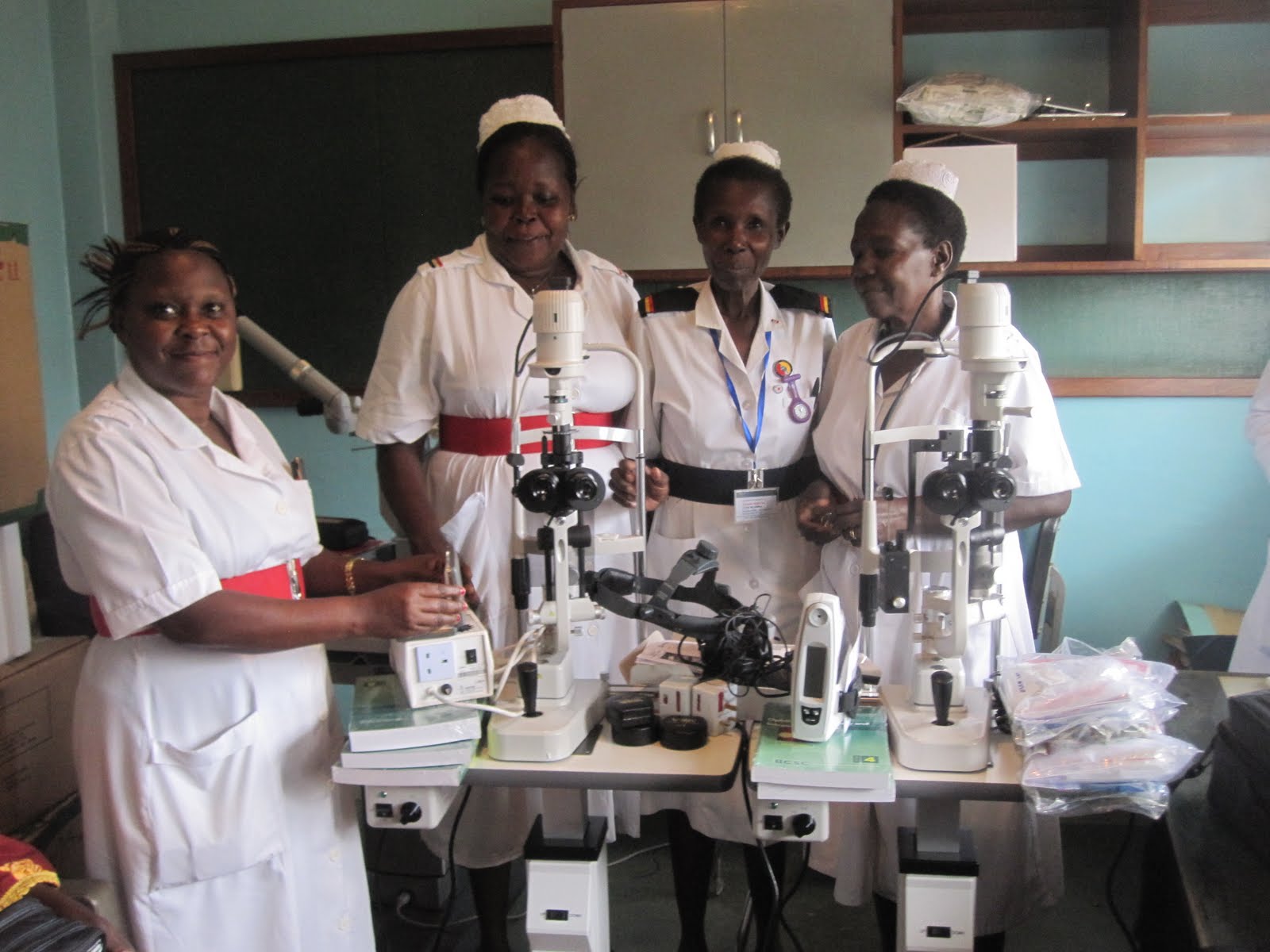
The nurses were so excited for all the equipment.  They will be using it along with the doctors and they realize that they can improve their care with such equipment.

Fellow nurses - always fun to meet your fellow nurses no matter where it may be.
The nurses didn't want to see us leave and kept thanking us for coming and helping their clinic.  They asked if we would like to "take refreshment" with them.  they took us to the University Canteen for a drink.  While we were visiting and learning about nursing in Uganda we gave them a gift -  a CTR ring.  They tried to guess what CTR meant and were very pleased when we told them it meant CHOOSE THE RIGHT.  They felt that fit nurses very well as nurses need to practice Christ like principles.  Did I say they were pleased, well they were thrilled to get a gift and a ring was a very personable gesture.


All the girls had to get a picture.  Interesting how we all bonded and had a hard time saying good bye.  Never say good bye in Africa just - Till we meet again.

The day wasn't over yet.  dr. Hunsaker was asked to go on television as the guest on Health Forum.  This is a call in show, last one hour and he was to field questions from the commentator and the public calling in.  He did us all proud as he answered all the questions and was able to explain a little about the church program of supporting ophthalmology in many countries around the world.

Thanks Dr. Hunsaker, Diane and Karen for a great project. 

A lot of good was done and there are a lot of happy people.  We wondered if this was going to be a good partnership and it turns out that much good will be done with all the new equipment.  Our partners are strengthened and we can't ask for much more. 


Thursday, August 11, 2011

Amuria

Amuria is a north eastern district of Uganda in the Teso Region. the area has suffered many hardships in recent years with much of the population being displaced by LRA aggression which was exacerbated by Karimojong raiding and the impact of the severe flooding in 2007. Many of the people of this area are barely returning to their homes to begin again to work their farms and find a way of making a living for their families.

It is a beautiful farming community with a variety of crops: Cassava, Sweet potatoes, Groundnuts, Sorghum, Millet, Peas, Simsim, Cotton, Sunflower, Rice, Maize, Beans, Soybeans, and oranges .
Along with the farming of crops there is the raising of cattle and goats. Seems prosperous enough but today they are struggling with a severe drought which the government now predicts will turn into a famine in a few months. Hard to believe since just south of Amuria is the wetlands where there is water in abundance.
Life is difficult - poverty is common. Seems like they just can't get a leg up before something else hits them to push them down.

Back in January we received a request from Minister Ecweru, Minister of Emergency, Disaster Relief and Refugees, to have a water project in Amuria. Easy enough request but a hard project to get organized and started as the area is very remote and
many of the roads are not roads but trails making it difficult to work in the areas. Homes are very spartan in that as soon as you leave the town proper everyone lives in a mud hut with a thatched roof.
Interesting sites with in the city limits - a view of a bygone street light and yes that is a little tiny light bulb dangling from the fixture.
A school bus loaded with children, Actually we have seen 50 children in the back of a truck just standing and hanging on to the sides so this bus at least has seats.

It is not unusual to see goats sitting in the median of main street or cows walking down the middle of the road downtown. (Whose cows are they anyway?)
Taxis in this area are a bit different also, after all we are out in the country.
Some taxis are more familiar looking but in Amuria they are always loaded and you never know what you will see riding on top, a goat, chickens.
Now you have a picture of Amuria. A little bit of contemporary but a whole lot of country.
Seems Amuria does things a little bit different on these water projects and instead of getting right down to business you have to have a FLAG OFF to get the project started. (Flag off? What is that?)
We printed a banner as requested and headed to the Flag Off celebration. But since the ceremony was suppose to start at 10:00 AM we decided to visit a few of the schools we are going to be working on.
Old latrines will be replaced with new latrines along with each of the 15 schools getting a rainwater catchment system.

As a mission farewell gesture we have decided to give each school a tree to commemorate the project. We planted a Mango tree at two schools this trip 


Senior girl Perfect (note the headband Ryan which we gave her for helping us plant the tree.)
and gave a soccer ball (oops, football) to the school just for fun since most children play with a ball made of plastic bags and string.

At the second school we visited we found all the girls crocheting.
With a safety pin! Who would have thought. They were quite adept at it too. They were using a very stiff thread and it made a very tight stitch but very pretty how they were doing the color weave.
Bright eyes full of hope and joy. African children are good at finding ways to be happy and joyful.

Well, it was12:00 pm and we decided it must be time for the 10:00 am Flag Off (Ugandan time)..
As we drove into the clearing in the village there was the banner and several people peering through the brush. As soon as they saw us coming they started to dance and sing.
We got out of the car and they led us in with singing and dancing, yelling and warbling.and the waving of leaf bouquets, a sign of good fortune and celebration.
We sat under a very large old hardwood tree
while we listened to the music and singing of the local band. The music was very good especially considering it was made on local homemade instruments.
Harriet asked if she could translate the ceremony for me as it was in the local language. Nearly every village in this area of Uganda has their own language. Most people end us speaking about 5 languages in Uganda including English and Lugandan
The man who donated the land for this borehole welcomed us and thanked the church for giving his community water to relieve their suffering.
He was dressed in his best suit and danced for us in celebrating the beginning of the drilling
It wasn't long till Betty our community Hygiene/Sanitation trainer was so into the celebration that she pulled us up to dance with the group
Then everyone was up dancing and celebrating including all the district officers who had come to speak at the Flag Off.
Each song that was sung reinforced the joy of getting clean water, improving the sanitation of the community and helping families to be healthy and avoid disease.
Another song was sung by the village group
" One day God will ask what you have done.
We will all be judged by what we have given.
We pray to God to take care of all the people.
Who can save the world?
The one who can save the children,
Who can save the women,
Who can save the men.
Everyone has to be accountable for what they do while living."

The Deputy Commissioner of Amuria guaranteed that Amuria will own this project. He said that the district had 61% clean water coverage and 58% sanitation coverage. The church's water project would improve these statistics considerably with the wells, latrines, family latrine slabs and hygiene and sanitation training.


Ssimbwa (project monitor), Robert (Minister Ecweru's brother and our community liason), Francis Kalema (drilling company), Hannington Kihuntu (Latrine construction ) Betty (Hygiene/Sanitation Training)
Elder Barlow introduced the team to the community. He explained that this was the team that would be working in their community to make the project happen. It was important for each community to work with the team for a successful project.

Minster Ecweru's representative, Moses recognized Ssimbwa as a good liason for the church as he has worked to establish the borehole sites with the district. He stated that the gift from the church far exceeded what the district had budgeted for the year. He acknowledge the impact such a project will have on the health of families. He also explained the uniqueness of the project in providing things that the District had never included in their budget but would now like to make standard for projects in the District such as the girls washroom in the latrine and the clothes washing stations at the water sites. He stated that the community should appreciate the practicality of the project and the thought that went into the planning to make the most of the project.

The District chairman Alumee LC5 talked about the history of suffering in the area with the wars and unrest along with the fluctuating flooding and drought. Much of the population have recently returned to the area and have started to reestablish their homes. The need for clean water is great and the project is very timely. He directed the new Disitrict Team to take advantage of this opportunity and work to gether to deliver the proper services to the community such as roads, well staffed health centers and additional water resources.
He declared the drilling officially launched.

2011 District Budget
9 school latrines
9 boreholes

Church project
15 school latrines with hand washing stations
15 school rainwater catchment systems
600 family latrine slabs
10 new boreholes
10 refurbished boreholes
10 clothes washing stations
20 communities Hygiene/Sanitation Training
15 schools Hygiene/Sanitation Training

They turned on the drilling machine and immediately there was water (staged a little but still an impressive site.
We planted trees to commemorate the Flag off and to leave the community a symbol of the growing change coming to their community.

The owner of the property for this first well obviously was suffering from cataracts as was his wife.

We had with us some glasses (magnifiers) so we gave them each a pair with a high power. They were elated as was all those around them who cheered their good fortune.

Time to leave we had a long ride home, 6 hours to Kampala.

Three stops on the way home. Farrell had to gas up at the TOTAL Station for our long trek home.


I had to visit the Thursday market and buy some baskets I couldn't live without

Ssimbwa had to stop and buy some newly harvested rice to feed his school children.


A great trip to Amuria.
The water project has begun.
A Flag Off!
That was a first for us.